
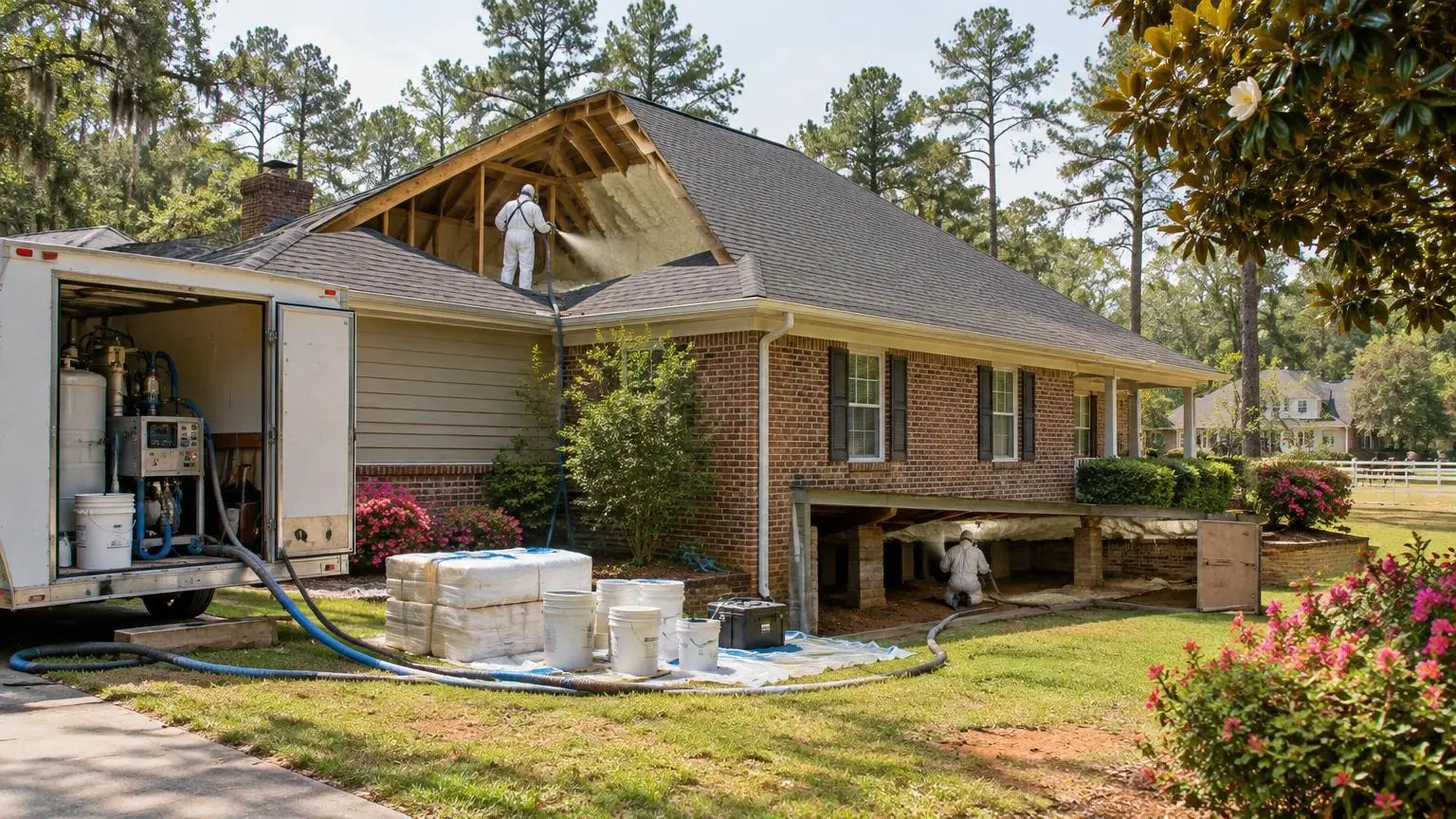
Insulation for long, humid Augusta summers
Spray Foam Insulation in Augusta, GA
Attic, crawl space and metal building insulation on both sides of the Savannah River.
- Free on-site estimates on both sides of the river
- Written quotes listing material, thickness and R-value area by area
- Crawl spaces checked for moisture and pest access before anything is sealed
Built for Heat, Humidity and Hot Attics
Spray foam insulation in Augusta is mostly about keeping summer heat and humidity out. Wikipedia's climate summary for the city notes a humid subtropical climate with very hot, humid summers: July averages 81.6F around the clock, 82 days a year reach 90F or more, and about five and a half days hit 100F. The record is 108F. Winters are short but not trivial, with 53 nights at or below freezing. Homes here lose most of their comfort through hot attics with ductwork in them and through damp, vented crawl spaces. We seal those spaces and insulate them, using open-cell or closed-cell foam where foam belongs and blown-in insulation where it does the job for less.
What the codes say on each side of the river
OpenEI's Climate Zone 3A list includes Richmond, Columbia and McDuffie counties in Georgia and Aiken and Edgefield counties in South Carolina, so the whole market is Zone 3A. On the Georgia side, the Insulation Institute's summary of Georgia's energy code (the 2015 IECC with Georgia amendments, effective January 1, 2020) lists R-38 ceilings and R-13 walls, with a 5 ACH50 air-tightness limit. On the South Carolina side, the state's Building Codes Council lists the 2009 IECC as the mandatory energy code by statute since January 1, 2013. For older homes, the Department of Energy suggests R-49 to R-60 for an uninsulated Zone 3 attic.
Ducts in the attic
In most Augusta-area homes the air handler and ductwork live in the attic, where summer temperatures run far above the outdoor air. Every leak in those ducts and every gap in the ceiling below them costs cooling. There are two approaches. One keeps the attic vented: seal the ceiling, seal the ducts, and blow loose fill deep on the attic floor. The other brings the attic inside: spray foam on the underside of the roof deck and gable walls, so the ducts sit in a space close to indoor temperature. We explain both and quote the one that fits your house, or both side by side.
Crawl spaces
Many older homes and plenty of newer ones sit over vented crawl spaces. In a humid summer, outdoor air entering through the vents is wetter than the cool crawl space can hold, so moisture condenses on joists, ducts and pipes. Fiberglass batts between floor joists absorb it, sag and fall. Sealing the vents, laying a heavy vapor barrier and insulating the crawl walls with closed-cell foam is the common fix. HomeGuide lists crawl space encapsulation at $3 to $10 per square foot.
Closed cell vs open cell
Open-cell foam is light and spongy, R-3.5 to R-3.7 per inch in HomeGuide's figures, and it is the usual choice for roof decks in our climate because it seals the deck and allows some drying. Closed-cell foam is dense, R-5 to R-7 per inch, and resists water, which makes it the pick for crawl space walls, rim joists and metal buildings. Neither is the cheapest way to insulate an open attic floor; blown cellulose or fiberglass is.
Questions to ask insulation contractors
When you call spray foam insulation contractors or insulation companies around Augusta, ask which foam goes where and why, what thickness and R-value the quote lists, how they handle attic ventilation if they spray the roof deck, and how they leave access for termite inspections in a crawl space. Ask how long you need to stay out after spraying; HomeGuide's guidance is at least 24 hours. A careful contractor puts the answers in writing.
Spray foam insulation cost
HomeGuide's 2026 guide puts installed spray foam at $1.50 to $5.00 per square foot: open-cell $1.50 to $3.50, closed-cell $3.00 to $5.00. It lists roof deck foam at $1,500 to $9,000 and whole houses at $8,000 to $20,000, and notes many installers have a $1,000 to $2,000 minimum. Fixr puts crawl space foam at $1,000 to $5,900. Locally, roof pitch, attic access around ductwork and crawl space height drive the price. Your written estimate is the number you pay.
Georgia Power program
Georgia Power's Home Energy Improvement Program page lists incentives for attic insulation when the existing level is R-38 or less and the whole attic is brought up to R-49, plus air sealing and duct sealing done through an affiliated installer. Check the current rules and amounts on its page before you start. We are not part of the program and do not promise a rebate.
Insulation Services
Six services shaped around hot attics, humid crawl spaces and the metal buildings common on rural lots.
Spray Foam Insulation
Open-cell foam for roof decks, closed-cell for crawl spaces, rim joists and metal.
Learn more →Attic Insulation & Air Sealing
Seal the ceiling and ducts, then insulate the attic deep, or bring the attic inside with foam.
Learn more →Crawl Space Insulation & Encapsulation
Seal vents, lay a vapor barrier and foam the walls to stop crawl space humidity.
Learn more →Metal Building & Shop Insulation
Closed-cell foam for metal shops, barns and garages to cut heat and stop condensation.
Learn more →Blown-In Insulation
Cellulose and fiberglass blown deep into attics, and dense-packed into empty walls.
Learn more →Insulation Removal & Replacement
Out with wet, moldy or pest-damaged insulation, then sealing and new insulation.
Learn more →
Common Questions
What can spray foam have the highest R-value?
Closed-cell foam, at about R-5 to R-7 per inch according to HomeGuide, against R-3.5 to R-3.7 for open-cell. In Augusta, closed-cell goes on crawl space walls and metal buildings; open-cell is common on roof decks.
Can mold grow behind spray foam insulation?
Mold needs moisture. Foam installed over a leak or on damp wood can trap that moisture, which is why we check for leaks and wet framing first. Properly installed foam keeps humid air off cool surfaces, which reduces condensation.
Does Home Depot sell closed-cell spray foam insulation?
Home stores sell small closed-cell foam kits and cans for gaps and small areas. Larger jobs like roof decks and crawl spaces use professional two-part rigs that control mix, temperature and thickness. We list foam type and thickness on every quote.
Who manufactures spray foam insulation?
Several national chemical companies make spray foam systems. For you, the type, thickness and installation matter most, and those are written on our quote.
What R-value is required in an Augusta attic?
The Insulation Institute's summary of Georgia's code lists R-38 ceilings for new work in our zone; Richmond and Columbia counties are Zone 3A. DOE suggests R-49 to R-60 for an uninsulated Zone 3 attic. South Carolina uses the 2009 IECC statewide.
Should I spray foam my roof deck or insulate the attic floor?
If your ductwork and air handler are in the attic, foaming the roof deck puts them inside a cooler space. If the attic is open and ducts are in good shape, sealing the ceiling and blowing loose fill deep usually costs less. We price both when both make sense.
Why Homeowners Call Spray Foam Insulation Augusta
We look before we price
Every quote follows a visit to the attic, crawl space and any building you want done.
Ducts considered
We plan around attic ductwork instead of burying leaks under insulation.
Moisture first
Crawl space water, leaks and rot are named before anything is sealed.
Comparable quotes
Material, thickness, R-value and price for each area, in writing.

Where We Work
We work in Augusta and Hephzibah in Richmond County; Martinez, Evans, Grovetown, Appling and Harlem in Columbia County; Thomson in McDuffie County; and across the river in North Augusta, Belvedere, Graniteville and Aiken. Columbia County's suburbs hold mostly newer brick homes with attic ductwork, Augusta and Graniteville have older mill-era and early 20th-century houses, and the rural edges have more metal shops and barns. Each town page covers what is different there.
- Spray Foam Insulation in Augusta, GA
- Spray Foam Insulation in Martinez, GA
- Spray Foam Insulation in Evans, GA
- Spray Foam Insulation in Grovetown, GA
- Spray Foam Insulation in Harlem, GA
- Spray Foam Insulation in Hephzibah, GA
- Spray Foam Insulation in Appling, GA
- Spray Foam Insulation in Thomson, GA
- Spray Foam Insulation in North Augusta, SC
- Spray Foam Insulation in Belvedere, SC
- Spray Foam Insulation in Graniteville, SC
- Spray Foam Insulation in Aiken, SC
Get a Spray Foam Insulation Estimate in Augusta
Book a free visit before the next cooling season.